
Starting a new video game can feel like walking into a conversation halfway through. Someone says “GG,” another player asks you to “rotate,” a teammate calls for “heals,” and the chat suddenly fills with abbreviations such as “DPS,” “NPC,” and “AFK.” You may understand the game’s controls but still feel unsure about what everyone is talking about.
That language is part of gaming culture. Players use short expressions to communicate quickly, describe strategies, identify roles, and react to what is happening on screen. Some terms are shared across many genres, while others have a special meaning in shooters, role-playing games, sports simulations, strategy games, or esports.
This beginner-friendly glossary explains the gaming terminology you are most likely to encounter in the United States, from basic gameplay words to online multiplayer slang. Each definition is written in plain English, with examples to show how the term is used in a real gaming situation. You do not need to memorise every expression before you play. Use this guide as a reference and return to it whenever a new word appears.
Why learning gaming terminology makes playing easier
Knowing common gaming terms does more than help you understand chat. It can make tutorials easier to follow, help you cooperate with teammates, and make it simpler to compare games before downloading or buying one.
- Understand instructions faster: words such as objective, checkpoint, cooldown, and respawn describe common game systems.
- Communicate with teammates: short calls such as “push,” “back up,” or “I need heals” can convey useful information quickly.
- Choose games with confidence: terms such as co-op, PvP, open world, and cross-platform describe the type of experience a game offers.
- Follow gaming content: streams, walkthroughs, reviews, tournament coverage, and community discussions often use the same vocabulary.
One important point: terminology is not always universal. A word can have a slightly different meaning depending on the game, genre, platform, or community. When in doubt, check the game’s tutorial or ask teammates what they mean.
Essential gaming terms every beginner should know
Gameplay: The way a player interacts with a game, including its rules, controls, challenges, and objectives. Example: “The graphics look great, but I want to know whether the gameplay is enjoyable.”
Objective: The task or goal a player must complete to progress or win. Example: “Our objective is to capture the control point.”
Mission / Quest: A task assigned by the game, often involving exploration, combat, collecting items, or helping a character. Example: “I need to finish this quest before unlocking the next area.”
Level: A stage, area, or section of a game. In some games, it also describes a character’s experience rank. Example: “This level introduces a new enemy type.”
XP (Experience Points) Points earned through gameplay that may increase a character’s level or unlock abilities. Example: “Completing the mission gave me enough XP to level up.”
Level up To advance to a higher character level, usually by earning XP or meeting a requirement. Example: “I levelled up and unlocked a new skill.”
Checkpoint: A saved progress point that lets a player resume from a particular place after failure or interruption. Example: “I reached the checkpoint just before the boss fight.”
Save point: A location or feature where game progress can be saved. Some games save automatically; others require manual saving. Example: “I am going to save before exploring the next area.”
Tutorial An introduction that teaches controls, mechanics, rules, or basic strategies. Example: “The tutorial showed me how to block and dodge.”
Boss / Boss fight A major enemy, often stronger or more complex than ordinary opponents, usually appearing at the end of a stage or mission. Example: “The boss fight took several attempts because I had to learn its attack pattern.”
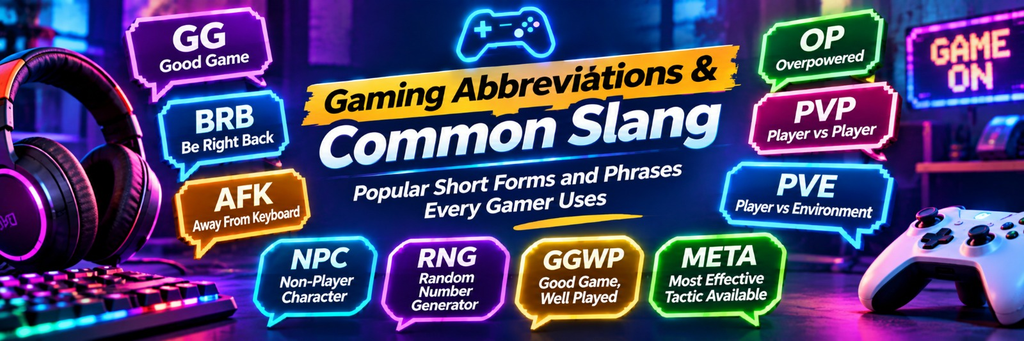
NPC (Non-Player Character): A character controlled by the game rather than by a human player. NPCs may provide missions, information, services, or story context. Example: “Talk to the NPC near the entrance to receive the next quest.”
AI (Artificial Intelligence): In games, AI commonly refers to computer-controlled characters or systems that react to player actions. Example: “The enemy AI changes its tactics when you move behind cover.”
Difficulty setting: A selectable level of challenge, such as easy, normal, hard, or expert. The exact options vary by game. Example: “I chose normal difficulty while learning the controls.”
DLC (Downloadable Content): Additional game content released separately or included in an expansion, such as new maps, missions, characters, or story chapters. Example: “The DLC adds a new campaign to the original game.”
Patch: A software update that fixes bugs, adjusts balance, improves performance, or changes game features. Example: “The latest patch fixed a matchmaking issue.”
Bug / Glitch: A bug is an unintended software problem. A glitch is often a visible or exploitable behaviour caused by a bug or design issue. Example: “A glitch made my character get stuck inside a wall.”
Online multiplayer and team communication
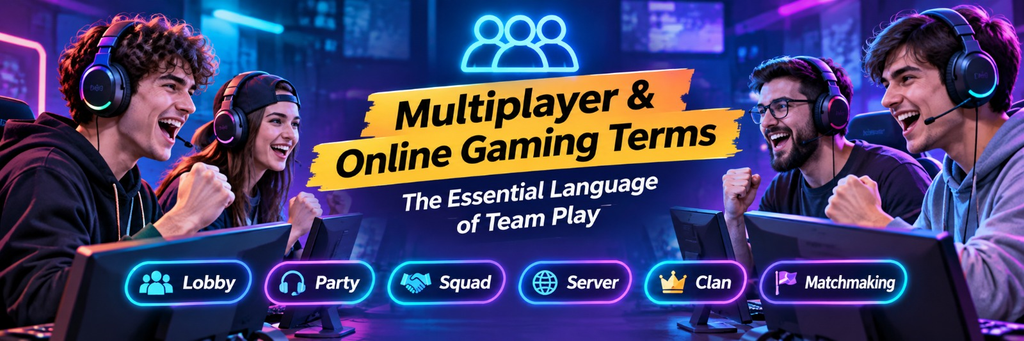
Online multiplayer games bring players together through the internet. Because teammates may have only a few seconds to react, communities develop short phrases for common situations.
Multiplayer A game mode or game designed for more than one human player. Example: “This game supports multiplayer with friends.”
Co-op (Cooperative): A mode in which players work together toward shared objectives rather than competing against one another. Example: “We played the campaign in co-op mode.”
PvP (Player versus Player): A mode in which human players compete against other human players. Example: “The arena has a PvP match every round.”
PvE (Player versus Environment): Gameplay in which players primarily fight computer-controlled enemies or overcome game challenges. Example: “I prefer PvE missions because I can explore at my own pace.”
Party / Squad: A group of players who team up, often before entering a match. The exact group size depends on the game. Example: “Invite me to your party and we can queue together.”
Lobby: A waiting area where players gather before a match or activity begins. Example: “I am in the lobby. Send the invite.”
Matchmaking: The system that finds and groups players for a game, sometimes using skill, location, connection quality, or selected preferences. Example: “Matchmaking is taking longer than usual tonight.”
Queue: A waiting line for matchmaking or an in-game activity. Example: “We are still in the queue for ranked mode.”
Server A computer or network system that hosts online game sessions or manages game services. Example: “The server disconnected during the match.”
Ping: A measurement of the time it takes data to travel between a player’s device and a game server, usually shown in milliseconds. Lower ping generally means less network delay. Example: “My ping jumped to 180 ms, so my actions felt delayed.”
Lag: A delay or interruption in a game’s response. It may be caused by network conditions, device performance, or server issues. Example: “I experienced lag when several players entered the area.”
Latency: The time delay between an action and the system’s response. In online games, network latency can affect how quickly actions appear to register. Example: “High latency made aiming feel less responsive.”
Disconnect: To lose the connection to a game session or server. Example: “I disconnected just before the match ended.”
AFK (Away From Keyboard): A player is temporarily away and may not be actively controlling their character. The phrase is also used by console and mobile players. Example: “I will be AFK for two minutes.”
GG (Good Game) A common expression used at the end of a match to show sportsmanship, regardless of whether the player won or lost. Example: “GG everyone. That was a close match.”
GLHF (Good Luck, Have Fun): A friendly phrase often used before a match begins. Example: “GLHF, team!”
Rage quit: Leaving a game abruptly out of frustration, often after a setback or loss. Example: “He rage quit after the other team scored.”
Toxic behaviour: Hostile or abusive conduct that makes a gaming environment unpleasant, such as harassment, insults, or repeated disruptive behaviour. Example: “Report toxic behaviour instead of escalating the argument.”
Griefing: Deliberately disrupting other players’ experience, often by sabotaging teammates or interfering with objectives. Example: “The player was griefing by blocking the team’s progress.”
Combat, roles and strategy terms
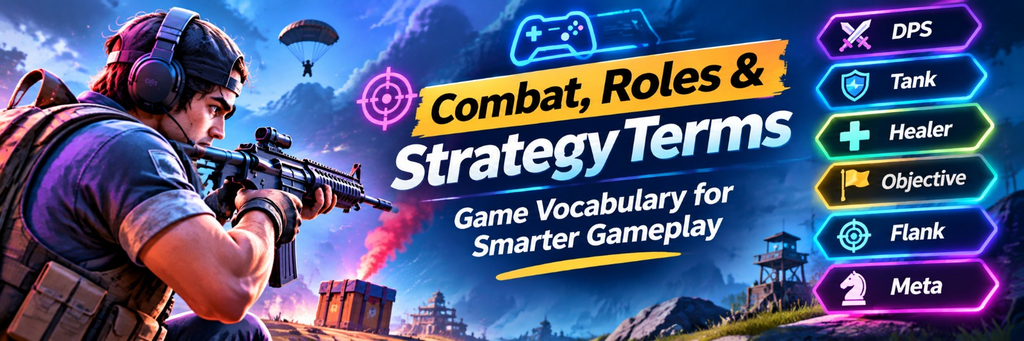
These expressions are especially common in action games, team shooters, multiplayer online battle arenas (MOBAs), and tactical games. The precise meaning can change between titles, but the general ideas are widely recognised.
HP (Health Points) / Health: A measure of how much damage a character can take before being defeated or eliminated. Example: “My HP is low, so I need to find cover.”
MP (Mana Points) / Mana: A resource used by some games to activate spells or special abilities. Example: “I cannot cast the spell because I am out of mana.”
Damage: The amount of harm an attack or effect causes to a character, enemy, or object. Example: “That weapon deals more damage at close range.”
DPS (Damage Per Second): A measure of how much damage a character, weapon, or team can deal over time. It can also refer to a damage-focused role. Example: “The team needs more DPS to defeat the boss quickly.”
Tank: A role or character built to absorb damage, protect teammates, or draw enemy attention. Example: “The tank should lead the group into the fight.”
Healer / Support: A role focused on restoring health, protecting teammates, providing buffs, or enabling the team. Example: “The healer kept the squad alive during the final round.”
Buff An improvement to a character, weapon, ability, or item. A buff may increase damage, speed, defence, or another attribute. Example: “The update buffed the character’s special ability.”
Nerf A change that makes a character, weapon, item, or ability less powerful, often to improve game balance. Example: “The weapon was nerfed because it was too strong.”
Cooldown: The waiting period before an ability, item, or action can be used again. Example: “Use your shield carefully because it has a long cooldown.”
Respawn To return to the game after being eliminated or defeated, if the game mode allows it. Example: “I will respawn in five seconds.”
Loadout: The selected combination of weapons, equipment, abilities, or items a player takes into a match. Example: “I changed my loadout to suit a long-range map.”
Hitbox: The invisible area used by a game to detect whether an attack or collision has hit a character or object. Example: “The character’s hitbox can affect how shots register.”
Headshot A hit that lands on an opponent’s head. Many shooters award extra damage for headshots. Example: “A clean headshot eliminated the opponent.”
Critical hit / Crit: An attack that deals extra damage or triggers a special effect under the game’s rules. Example: “The critical hit defeated the enemy in one strike.”
AoE (Area of Effect): An attack, spell, or ability that affects an area rather than a single target. Example: “Move away from the marked circle before the AoE attack lands.”
Aggro The attention or hostility an enemy directs toward a player. In many games, certain actions make enemies target a particular character. Example: “The tank took aggro so the rest of the team could attack.”
Flank: To approach an opponent from the side or rear rather than directly from the front. Example: “Two players are trying to flank us from the left.”
Push: To move forward aggressively toward an opponent, position, or objective. Example: “Push together after the other team uses its abilities.”
Rotate: To move from one area, lane, or objective to another, often to support teammates or respond to changing conditions. Example: “Rotate to the other site because the opponents are attacking there.”
Camping: Staying in one location for an extended period, often to defend an area or wait for opponents. Example: “The opponent is camping near the doorway.”
Cover An object or position that protects a player from enemy attacks or line of sight. Example: “Get behind cover while your teammate revives you.”
Revive: To bring a downed or incapacitated teammate back into active play, when the game allows it. Example: “Cover me while I revive our teammate.”
Objective play: Actions focused on completing the match goal rather than simply eliminating opponents. Example: “We won because we focused on objective play.”
Game modes, genres and play styles
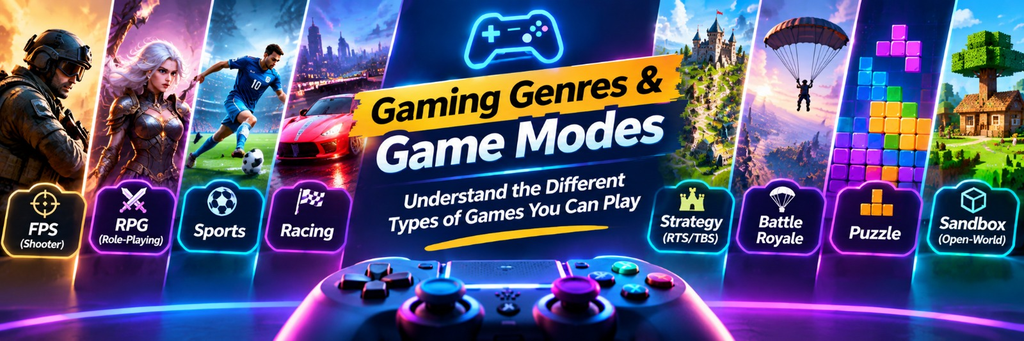
FPS (First-Person Shooter): A shooter viewed through the character’s eyes, so the player sees the world from a first-person perspective. Example: “A tactical FPS often rewards communication and careful positioning.”
TPS (Third-Person Shooter): A shooter in which the camera shows the character from behind or another external angle. Example: “A TPS can make it easier to see the character and nearby surroundings.”
RPG (Role-Playing Game) A game in which players develop characters, make choices, complete quests, and often shape a story. Example: “The RPG lets you customise your character’s skills.”
MMORPG (Massively Multiplayer Online Role-Playing Game): An online role-playing game in which many players share a persistent world. Example: “In an MMORPG, players may join guilds and complete group raids.”
MOBA (Multiplayer Online Battle Arena): A team-based game genre in which players control characters with distinct abilities and compete to achieve an objective, often by advancing through lanes. Example: “The MOBA match depends on teamwork and map control.”
Battle Royale: A game mode in which many players or teams compete until one player or team remains, often while the playable area shrinks. Example: “We survived until the final circle in the battle royale.”
Open world: A game structure that allows players to explore a large environment with substantial freedom in how and when they approach activities. Example: “The open-world game lets you explore beyond the main story.”
Sandbox game: A game that gives players tools or systems to create, experiment, or choose their own goals, rather than following only a fixed sequence. Example: “The sandbox mode lets players build their own worlds.”
Roguelike / Roguelite: Terms used for games built around repeated runs, procedural variation, and the possibility of losing progress after failure. The distinction varies by community and game. Example: “Each run feels different because the map and rewards change.”
Survival game: A game focused on managing resources and staying alive in a challenging environment. Example: “We collected food and materials before nightfall.”
Simulation game: A game that recreates or models activities, systems, or environments, such as driving, farming, or city management. Example: “The flight simulation aims to model aircraft controls.”
Ranked mode: A competitive mode in which results affect a player’s rating, rank, or league standing. Example: “I am practising in casual mode before playing ranked.”
Casual mode A less formal mode that usually places less emphasis on competitive ranking. Example: “Let’s play casual matches while we learn the map.”
Custom game A player-created session with selected settings, rules, maps, or participants. Example: “We set up a custom game for a private match.”
Cross-play / Cross-platform play A feature that allows players on different platforms, such as PC and console, to play together when supported. Example: “Cross-play lets my friends on console join my PC lobby.”
Cross-progression: A feature that allows certain progress or account information to carry across supported platforms. Example: “My unlocked items are available on both devices because the game supports cross-progression.”
Progression, items and in-game economies
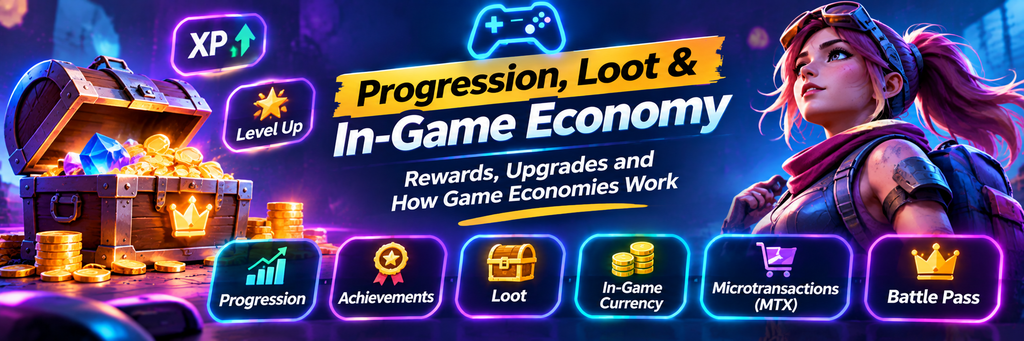
Inventory: The collection or storage space for items a player has collected or equipped. Example: “My inventory is full, so I need to drop some materials.”
Loot: Items or rewards collected during gameplay, often from defeated enemies, chests, missions, or exploration. Example: “The boss dropped rare loot.”
Drop: An item or reward that appears in the game, often after defeating an enemy or completing an activity. Example: “That enemy has a chance to drop crafting materials.”
Rare / Epic / Legendary: Common labels used to indicate item rarity or tier. The colour and exact hierarchy vary by game. Example: “I found a legendary item, but it does not fit my build.”
Crafting: Combining collected materials or resources to create items, equipment, or upgrades. Example: “I need more metal to craft the armour.”
Upgrade: An improvement to equipment, a character, a base, or an ability. Example: “I saved enough resources to upgrade my weapon.”
Skill tree: A progression system that lets players unlock or improve abilities along different paths. Example: “I chose the defensive branch of the skill tree.”
Build: A chosen combination of character attributes, abilities, equipment, or items designed for a particular play style. Example: “This build focuses on mobility rather than defence.”
Meta A term for strategies, characters, equipment, or tactics considered especially effective in the current state of a game. The meta can change after updates. Example: “The latest patch changed the competitive meta.”
Microtransaction: A small digital purchase made within a game, often for cosmetic items, currency, or optional content. Example: “The game offers cosmetic microtransactions.”
Cosmetic: An item or option that changes appearance without necessarily changing gameplay performance. Example: “The skin is cosmetic, so it does not improve weapon damage.”
Battle pass: A progression system that rewards players with items as they complete challenges or earn progress during a limited period. Some passes are free, paid, or have multiple tracks. Example: “I unlocked a new outfit through the battle pass.”
Loot box A digital item or feature that provides a randomised reward. The contents and purchase rules vary by game and region. Example: “The loot box contains a random cosmetic reward.”
Pay-to-win (P2W): A criticism used when spending real money can provide a meaningful gameplay advantage over players who do not pay. Example: “Players call it pay-to-win because paid upgrades affect competitive strength.”
Free-to-play (F2P): A game that can be played without an upfront purchase, although it may offer optional purchases or other monetisation. Example: “The free-to-play game sells optional character skins.”
Early access: A release model in which players can purchase or play a game while it is still being developed. Features may change before full release. Example: “The studio says the game is in early access and still being updated.”
Beta: A pre-release testing version used to identify issues and gather feedback. Access may be public or limited. Example: “I joined the open beta to test the multiplayer mode.”
Streaming, esports and gaming community language
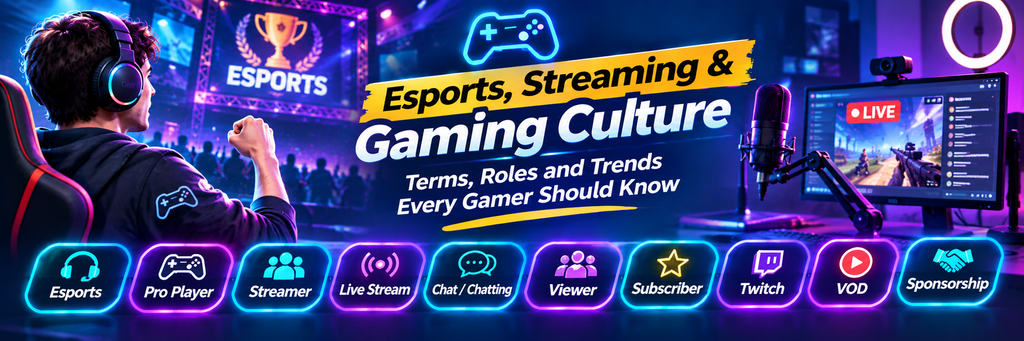
Esports: organised competitive video gaming, often involving teams, leagues, tournaments, coaches, and professional players. Example: “The team qualified for an esports tournament.”
Streamer: A person who broadcasts live gameplay or gaming-related content to an online audience. Example: “The streamer explained the strategy while playing.”
Livestream: A real-time video broadcast, often featuring gameplay, commentary, or interaction with viewers. Example: “The developer hosted a livestream to reveal the update.”
VOD (Video on Demand): A recorded broadcast or video that viewers can watch after the live stream ends. Example: “I watched the VOD to catch the part I missed.”
Clip: A short recorded segment taken from a longer gameplay session or stream. Example: “That final-round play made a great clip.”
Caster / Commentator: A person who provides live commentary during an esports match or gaming event. Example: “The caster explained why the team changed its strategy.”
Scrim A practice match, usually between teams preparing for competition. Example: “The team scheduled a scrim against another club.”
Bracket A tournament structure showing matchups and how winners advance. Example: “The team moved to the upper bracket after winning.”
LAN (Local Area Network) event: A gaming event where participants connect computers or consoles through a local network, often in the same venue. The term is also used more broadly for in-person gaming events. Example: “The players travelled to a LAN event for the finals.”
Patch notes The published list of changes included in a game update. Example: “Read the patch notes to see which abilities changed.”
GGWP (Good Game, Well Played) A variation of “GG” that acknowledges a good match or performance. Example: “GGWP to the other team.”
Noob / Newbie: Informal terms for a new or inexperienced player. “Newbie” is generally more neutral; “noob” can be teasing or insulting depending on context. Example: “I am a newbie, so I am still learning the maps.”
Clutch: A high-pressure moment in which a player succeeds despite difficult odds, such as winning a round while outnumbered. Example: “That was a clutch play in the final seconds.”
Carry: To contribute so strongly to a team’s success that one player appears to be doing much of the work. Example: “Our teammate carried the final round.”
Smurfing: When an experienced player uses a lower-ranked or new account to play against less experienced opponents. Example: “The match felt unfair because one player seemed to be smurfing.”
Cheating / Hack: Using unauthorised software, exploits, or methods to gain an unfair advantage. Example: “The game banned the account for using cheats.”
Exploit: Using an unintended game behaviour or loophole to gain an advantage. Some exploits are treated as cheating under a game’s rules. Example: “The developer fixed an exploit that let players leave the map.”
Common gaming abbreviations at a glance
| Abbreviation | Full form / meaning | In plain English |
| AFK | Away From Keyboard | Temporarily away from active play. |
| AoE | Area of Effect | An ability or attack that affects an area. |
| DLC | Downloadable Content | Additional content released for a game. |
| DPS | Damage Per Second | Damage output over time; sometimes a damage role. |
| FPS | First-Person Shooter / Frames Per Second | A shooter genre, or a measure of how many frames are displayed each second. Context determines the meaning. |
| GG | Good Game | A sportsmanlike expression after a match. |
| GLHF | Good Luck, Have Fun | A friendly pre-match greeting. |
| HP | Health Points | A measure of a character’s health. |
| HUD | Heads-Up Display | On-screen information such as health, map, ammo, and objectives. |
| MMO | Massively Multiplayer Online | A game designed for many players in a shared online environment. |
| MMORPG | Massively Multiplayer Online Role-Playing Game | An online role-playing game with a large shared world. |
| MOBA | Multiplayer Online Battle Arena | A team-based competitive game genre. |
| NPC | Non-Player Character | A character controlled by the game. |
| Ping | Network response time, usually in milliseconds | A lower value generally means less delay in communication with the server. |
| PvE | Player versus Environment | Players face computer-controlled challenges. |
| PvP | Player versus Player | Players compete against other players. |
| RNG | Random Number Generator | A system used to produce random or chance-based outcomes. |
| RPG | Role-Playing Game | A genre focused on character development, choices, and often story. |
| TPS | Third-Person Shooter | A shooter viewed from an external camera perspective. |
| VOD | Video on Demand | A recording available to watch after a live broadcast. |
Gaming terms that can mean different things
Some words are especially easy to misunderstand because they have more than one meaning. Context matters:
- FPS can mean “first-person shooter” when discussing a genre, or “frames per second” when discussing performance. “I play FPS games” refers to the genre; “the game runs at 60 FPS” refers to frame rate.
- Ping is often used casually to describe connection quality, but it is specifically a measure of network round-trip time. A stable connection matters too.
- Meta can mean the most effective strategies in a game. It is not the same as the game’s official rules, and it can change after patches.
- Buff and nerf usually describe balance changes, but players may also use them informally to describe a character becoming stronger or weaker.
- Roguelike and roguelite are used inconsistently across the industry. Look at the actual mechanics rather than relying only on the label.
How to learn gaming language without feeling overwhelmed
You do not need to study a glossary before joining your first match. A few simple habits will help you pick up terminology naturally:
- Start with the tutorial. It usually explains the controls, objectives, resources, and special mechanics unique to that game.
- Learn the words connected to your role. If you play support, understand healing, buffs, cooldowns, and revives. If you play a shooter, learn cover, reload, aim, ping, and rotations.
- Watch one beginner-friendly guide. A short video can show how a term is used in context, which is often easier than memorising a definition.
- Use the in-game glossary or help menu. Many games explain their own systems and terminology.
- Ask a clear question. “What does rotate mean in this game?” is more useful than pretending you understand.
- Keep communication respectful. Gaming slang can be playful, but insults and harassment are not a requirement for fitting in.
If you are a parent or guardian learning gaming language to understand a child’s online experience, focus first on the game’s communication tools, privacy settings, age rating, spending options, and reporting controls. Knowing the vocabulary can help you ask more informed questions, but it is not a substitute for checking the game’s safety features.
Frequently asked questions about gaming terminology
What does “GG” mean in gaming?
GG means “Good Game.” Players commonly use it at the end of a match to acknowledge the game and show sportsmanship. Tone matters: it can be sincere, playful, or occasionally sarcastic.
What does AFK mean?
AFK means “Away From Keyboard.” It describes a player who is temporarily away or not actively controlling their character. The expression is also used by players on consoles and mobile devices.
What is the difference between PvP and PvE?
PvP means Player versus Player, where human players compete against one another. PvE means Player versus Environment, where players face computer-controlled enemies or game challenges.
What does NPC mean?
NPC stands for Non-Player Character. It is a character controlled by the game rather than a human player. NPCs may provide missions, dialogue, services, or challenges.
What does DPS mean?
DPS means Damage Per Second. It measures damage dealt over time. In team games, “DPS” can also describe a role focused on dealing damage.
What is a gaming meta?
The meta is the set of strategies, characters, equipment, or tactics considered especially effective in the current version of a game. Updates and player discoveries can change it.
What does “nerf” mean?
A nerf is a change that reduces the power or effectiveness of a character, weapon, item, or ability. Developers may make nerfs to improve game balance.
What does “buff” mean?
A buff is an improvement that makes a character, weapon, item, or ability stronger or more useful.
What is the difference between FPS and FPS?
The abbreviation has two common meanings. First-person shooter is a game genre; frames per second is a performance measurement that describes how many frames are displayed each second.
What does “noob” mean?
Noob is slang for an inexperienced player. It can be used jokingly, but it can also be insulting. “New player” or “newbie” is usually more welcoming.
What is cross-play?
Cross-play allows people using different supported platforms, such as PC and console, to play together in the same game. Not every title or mode supports it.
What is a battle pass?
A battle pass is a progression system that rewards players for completing challenges or earning progress during a season or limited period. It may include free and paid reward tracks.
Conclusion: Learn the language, then enjoy the game
Gaming terminology can seem like a language of its own, but most expressions describe familiar ideas: a goal to complete, a teammate to support, an opponent to outsmart, or a system that helps the game run. Once you recognise the most common words, tutorials become clearer and online conversations feel less intimidating.
Start with the terms you encounter most often in your favourite genre. Learn a few new expressions each time you play, and remember that different games may use the same word in different ways. The goal is not to sound like an expert. It is to understand the game, communicate clearly, and have a better experience.
Bookmark this glossary as your quick reference, and share it with a friend who is just getting started.